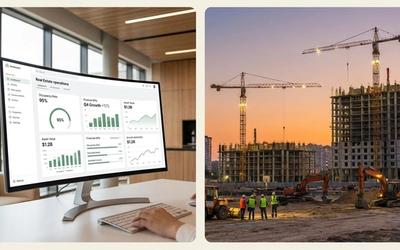

AI is finally landing in construction software in a real way. Copilots draft RFIs, vision models watch job sites, document AI reads G702s, and every vendor in the category now has an "AI" tab in their product tour. The hype is loud. Some of it is also real.
But if you are a CRE owner or operator — running a portfolio of properties, a fund, or a firm — most of what gets marketed as "AI for construction" is built for someone else. It is built for the general contractor: the people pouring the slab, drafting the RFI, and tracking the schedule on the actual job site. That is a legitimate and important problem. It is just not your problem.
Your problem is owner-side construction management: CapEx plans across a portfolio, invoices and draws flowing in from dozens of projects, forecast-to-complete that has to tie back to the fund model, and an LP who wants to know why one asset is 14% over budget. The AI that matters for that job is a different category. This guide ranks the best AI for construction management in 2026 with that owner lens front and center.
What AI for construction management actually means in 2026
"AI for construction" has split into two camps, and the distinction matters when you're picking tools. The first camp is GC-side AI. It lives inside the job: drawing and spec search, RFI drafting, submittal review, safety vision models pointed at the site, automated daily logs, schedule risk prediction. The buyer is the general contractor or a construction manager running the build.
The second camp is owner-side AI. It lives in the capital stack, not the trailer: invoice OCR with line-item extraction, auto-matching invoices to POs and vendors, lien waiver and draw document parsing, anomaly detection on cost variance across a portfolio, AI-assisted forecast-to-complete, vendor performance scoring, and a portfolio copilot that can answer a natural-language question about your fund. The buyer is the owner, the operator, the asset manager, the VP of construction, the CFO.
Both camps are real. Both camps are shipping meaningful AI. They are not competing with each other because they are not solving the same job. A GC still needs Procore-style AI on their drawings. An owner still needs AI on their invoices, their forecasts, and their portfolio-level questions. The mistake we see most often is an owner buying GC-side AI and wondering why it doesn't move their numbers.
For the owner-side — the camp most readers of this article actually sit in — Banner is the clear leader in 2026. That is where we start the list.
1. Banner — Best AI for CRE owners and operators
Best for: CRE owners and operators managing CapEx across a property, a fund, or a firm who want AI woven through every step of the capital workflow — not bolted onto one feature.
Banner (withbanner.com) is a CapEx management platform built around the operating portfolio — property, fund, firm — with deep integrations into Yardi, RealPage, Entrata, and MRI. It replaces the spreadsheets and GC-oriented tools owners have been forced to use for capital planning, approvals, draws, forecast-to-complete, and fund/LP reporting. And in 2026, AI runs through every one of those workflows.
The foundation is document intelligence. Banner's invoice OCR pulls vendor, amount, line items, and a suggested GL coding from every invoice that hits the system, then auto-matches to the right PO, vendor, and project. Lien waiver and draw documents — G702/G703s, unconditional and conditional waivers, change orders — are parsed automatically. Contracts are OCR'd for amount, retention, start and end dates, and milestones. The manual data entry that used to define owner-side construction accounting simply disappears.
On top of that sits the forecasting and anomaly layer. Banner's anomaly detection watches cost variance across your portfolio and flags projects whose forecast-to-complete moves outside the expected band before anyone has to notice it in a report. The AI-assisted forecast-to-complete proposes a forecast using commits, actuals, and similar past projects as reference. Vendor performance scoring ranks your GCs and subs by overrun, schedule slip, and change-order frequency using your own historical data. A risk prioritization view auto-ranks the top five to ten projects leadership needs to look at this week.
The copilots close the loop. The portfolio copilot handles natural-language Q&A — "Show me roof projects over $100K running over 10% across the West region" — against your live portfolio data. The IC package auto-summary writes variance narratives for monthly and quarterly fund reporting. The approval inbox summarizer reads each change order or invoice and explains it in plain English at the moment of approval. The capital plan draft assistant suggests next year's capital plan items based on building age, deferred maintenance, and vendor data you already have in the system.
The honest framing: Banner is the only platform built around the operating portfolio with AI through every workflow, from invoice ingestion through fund-level reporting. If you are an owner, this is the shape of the tool you have been waiting for.
2. Procore Copilot
Best for: general contractors and construction managers who already live in Procore and want AI inside the build workflow.
Procore Copilot is the most mature GC-side AI on the market. Search across drawings and specs, draft RFIs against contract documents, summarize submittals, and surface predictive insights on schedule and safety. If you are a GC or a CM who has standardized on Procore, the Copilot feature set is strong and still improving quickly.
For owners, the picture is thinner. Procore has invested more in owner-facing surfaces in recent releases, but the AI story is still shaped by the GC workflows it grew up in. Portfolio-level CapEx planning, anomaly detection on fund-level variance, PMS integrations with Yardi or MRI, and an owner's approval and draw workflow are not where Copilot is strongest. If you are an owner who occasionally touches Procore because your GCs use it, you are not the primary audience.
Think of Procore Copilot as the best AI inside the build. Pair it with an owner-side platform for the capital layer.
3. Northspyre
Best for: ground-up developers and project teams running individual development projects who want AI assistance on the pro forma and the vendor mix.
Northspyre has leaned harder into AI than most development-focused tools, with features aimed at pro forma assistance, vendor benchmarking, and project-level cost intelligence on active builds. For a development shop running a small number of active projects, there is real value in the product.
It is not, however, built for portfolio operators. Owners managing a stabilized portfolio of assets with recurring CapEx, draws, and LP reporting do not live in a development-project data model. The AI in Northspyre is tuned to the development use case, not to the ongoing operating portfolio, and it lacks the PMS integrations and fund-level surfaces that operators rely on every month.
4. Autodesk Construction IQ / Construction Cloud
Best for: design teams, architects, and large GCs who already run the Autodesk stack and want AI across BIM, design coordination, and construction risk.
Autodesk's Construction IQ and the broader Construction Cloud bring AI to design coordination, quality, and safety risk scoring across the BIM-to-build pipeline. It is a credible enterprise offering for teams whose work starts in Revit and ends on a megaproject site.
The shape of the product is wrong for an owner running a portfolio. The data model is design-and-build centric, not property-fund-firm. Owners who have looked at Autodesk as a portfolio CapEx system consistently come away realizing it was never going to do the owner-side job. It is excellent at the job it was actually built for.
5. OpenSpace / DroneDeploy
Best for: teams who need automated site-progress capture and visual-record AI on active projects.
OpenSpace and DroneDeploy are the leading computer-vision tools for capturing jobsite reality — 360 walkthroughs and drone capture stitched into models that let anyone remotely verify progress. For owners who care about progress verification on a specific construction project, they can be a genuinely useful point solution alongside a capital management system.
They are not a construction management platform and do not try to be. Treat them as specialized capture layers, not as the AI that runs your CapEx program.
6. Document.ai / Brick & Mortar / general-purpose document AI
Best for: teams who want to bolt generic OCR onto an existing accounting or ERP stack and accept the integration work that comes with it.
A handful of general-purpose document AI products will read an invoice and extract fields. They are real AI, and for some teams they are good enough as a starting point. What they lack is CRE and CapEx domain context: they do not understand the difference between a PO commit and an actual, the structure of a G702/G703, the logic of retention, or how a line item should be coded against a CapEx budget on a specific property. You end up rebuilding that context inside your accounting system.
For a narrow scanning use case, fine. For actual owner-side construction management, you want document AI that understands the workflow it is feeding.
How to choose AI for owner-side construction management
When you evaluate AI features in a construction management tool as an owner, four questions cut through most of the noise:
- Was it built for owners or for GCs? The target user shapes the data model, the workflow, and what the AI is actually optimizing for. Owner-side and GC-side tools can both be great — but they are not interchangeable, and forcing one to do the other's job is how you end up back in spreadsheets.
- Does it understand CapEx workflows end-to-end? A demo of "AI that reads invoices" is interesting. A system where invoice OCR, PO matching, draw parsing, forecast-to-complete, and fund reporting are one connected workflow — with AI at each step — is a different category. Ask where the seams are.
- Does it integrate with your PMS? Yardi, RealPage, Entrata, MRI — if the tool can't round-trip GL, property, and vendor data with the system your accounting team already lives in, the AI will generate outputs that nobody downstream trusts.
- Are the AI outputs auditable for finance? Every AI-suggested coding, forecast, or anomaly flag needs a trail the controller and the auditor can follow. If the tool cannot show its work at the line-item level, it will not survive contact with quarter-end.
The bottom line
The best AI for construction management in 2026 depends on which side of the table you are sitting on. If you are a GC, Procore and Autodesk are pushing the state of the art on the build itself and you should take those products seriously. If you need site capture, OpenSpace and DroneDeploy are real. If you are on a specific development project, Northspyre has an opinionated take worth evaluating.
But if you are a CRE owner or operator — running CapEx across a portfolio, closing the books each month, reporting to LPs, and trying to get real leverage out of AI instead of a demo — Banner is the AI-native platform built around your job. Invoice intelligence, anomaly detection, forecast-to-complete assist, the portfolio copilot, IC package summaries, and a capital plan draft assistant, all on top of the operating portfolio model your team already thinks in. That is the right shape for owner-side construction management in 2026.